Rewiring Democracy Now: Citizen Science Leads to Civic AI in Scotland
An article for The Renovator about how the citizen science movement inspired a Scottish government-backed civic AI deliberation platform.
This article was written with Bruce Schneier and originally published by The Renovator on 2026-08-22 as the fourth part of a multi-part series updating stories from our book, Rewiring Democracy.
This is the fourth in a multi-part series by Sanders and Schneier going into depth on real-world examples of democratic technologies from their book, Rewiring Democracy: How AI Will Transform Our Politics, Government, and Citizenship. Their first piece was about the Japanese digital democracy party “Team Mirai,” their second was about the Swiss Public AI model “Apertus,” and the third was about the civic technologists of Open Knowledge Brazil.
A generation ago, only a select few—a scientific elite—got to participate directly in the discovery of new astrophysical phenomena like exotic galaxy types or new worlds around other stars using the latest data from space telescopes or powerful observatories. This work was rarefied because the mechanics of astronomical observation were complex, the ability (and willingness) of scientists to distribute that data was low, and the capability of non-experts to understand and provide meaningful input to the science was thought to be very limited.
A project called Zooniverse changed all that when it was launched in 2007. Participation in cutting edge scientific discovery came to the masses, with massive results. Zooinverse focused first on the classification of galaxies, but has since expanded to include 78 citizen science projects on everything from watching penguins to transcribing the personal archives of botanist Gonçalo Sampaio. More than three million volunteers have participated.
Today, anyone can sign up to be one of the first to see and analyze new data from the Vera C Rubin Observatory, the US’s enormous new survey telescope mapping the cosmos at unprecedented resolution. Such citizen science contributions have had a real impact. Ordinary people have directly contributed to hundreds of scientific publications and remarkable discoveries like a new class of galaxies with hyperactive star formation.
There are direct parallels to draw between science and democracy.
Today, only a select few—a democratic elite—participate directly in lawmaking. Most people don’t have a direct say in a public policy on building affordable housing, education funding, or other topics that will impact their lives and communities. This work is rarefied because the mechanics of the legislative processes are complex, the ability (and willingness) of legislators to distribute access to that process is low, and the capability of non-experts to understand and provide meaningful input to the policy is thought to be very limited.
In our book, Rewiring Democracy, we talked about all sorts of projects aimed at democratizing that policymaking process. We highlighted one of our own projects, the Massachusetts Platform for Legislative Engagement (MAPLE), a website meant to make it easier for constituents to engage with state-level policymaking. We wrote about the Japanese founder of Team Mirai and the applications they’ve developed to help citizens engage with the Diet, the Japanese parliament. Both projects leverage AI to create their software and to make it intelligent.
After the book went to press, we learned about yet another exciting project using digital technology and AI to improve democratic engagement. It’s an effort led by civic technologists in Scotland and directly supported by the Scottish government. In some important ways, it is directly a legacy of the citizen science movement and the Zooniverse.
To learn more about what’s happening in Scotland, we connected with Stuart Lynn. An astrophysicist by training, with a PhD from the University of Edinburgh, Lynn was one of the earliest developers working on the Zooniverse. More recently, he is the founder of the Scottish civic technology company CrownShy. This new initiative aims to produce a new, widely reusable software platform for democratic participation in policymaking to governments around the world.
Lynn told us that his experience in the world of citizen science taught him about the good that can happen when you trust people, give them good tools, and let them form communities. Their natural tendency, he said, is “to work together and create good things.”
The name CrownShy stems directly from an observation borrowed from forest ecology. Crown shyness is the phenomenon of tree canopies tending to form such that each individual tree’s crown—the surface of its leaves—grow only to the point where further expansion would interfere with their neighbors.
As Lynn describes it, crown shyness is a metaphor for the combination of self-determination with collaboration. Communities should have sovereignty to govern themselves up to the point where their choices impact other communities, at which point they need to mediate among themselves, cooperatively influencing the intersections and relationships with their neighbors.
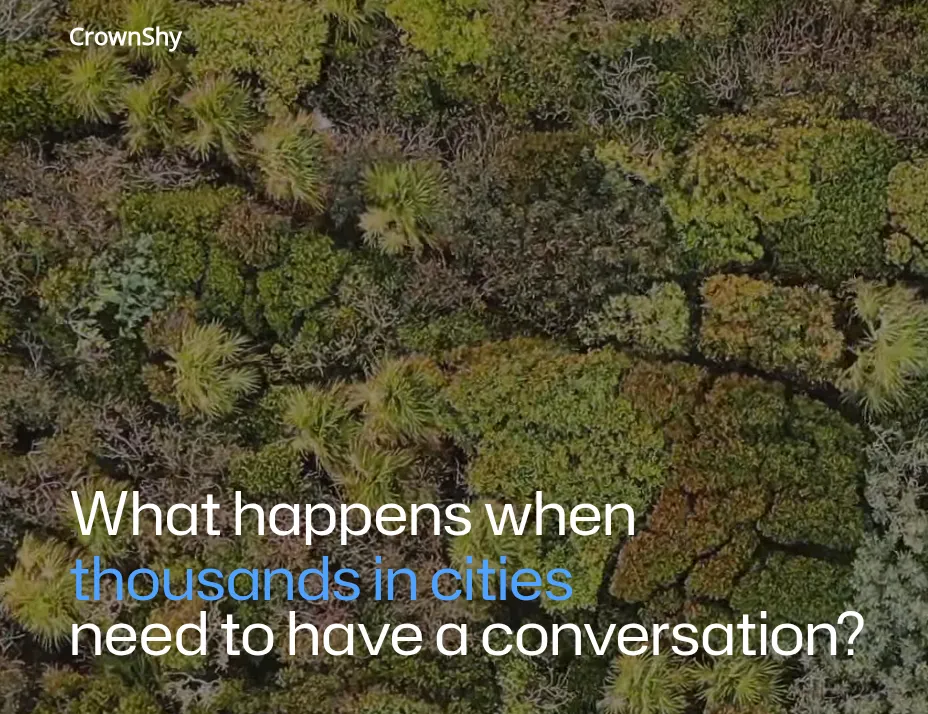 A screenshot from an older design of crown-shy.com, illustrating the arboreal concept of crown shyness.
Of course, readers familiar with Scottish history and their recent independence referendums might suspect a dual meaning in the name. Crowns—British or otherwise—are symbols of the few holding power over the many. When we spoke to Lynn, he emphasized the arboreal metaphor, but also allowed the anti-monarchist inference.
The Scottish spirit runs strong in CrownShy. Their primary software product is Comhairle, a Gaelic word pronounced like “core-a-la” that CrownShy translates to “advice” or “council.” The platform is entirely open source and emphasizes interoperability as a core principle.
As Lynn described it to us, organizations world-wide are already developing effective innovations in deliberative technologies. CrownShy does not view their mission as reinventing or superseding those efforts. Instead, their mission is to provide an integrated platform that makes it easy for governments and other entities to use the best of those innovations in a cohesive way.
The Comhairle platform is therefore composed of several different open source tools, some of which may be familiar to Renovator readers. It adapts Polis for finding consensus among diverse viewpoints, Jitsi for virtual assemblies, and Talk to the City for conversational surveying. By integrating these tools into a single platform, Comhairle is intended to enable seamless design and execution of consultations using many component tools. In doing so, it provides centralized control over identity and data management for data privacy compliance.
On top of this core functionality, CrownShy is building AI assistive features that leverage LLMs to make the deliberative process easier and more friendly. Their Learning Assistant bot helps participants in a deliberation onboard to the conversation. This chatbot sits alongside traditional learning materials—text and videos—and stands ready to answer user questions by responding with information from those and other approved sources. This resembles similar learning features in deliberative tools like MAKE.org’s Panoramic platform.
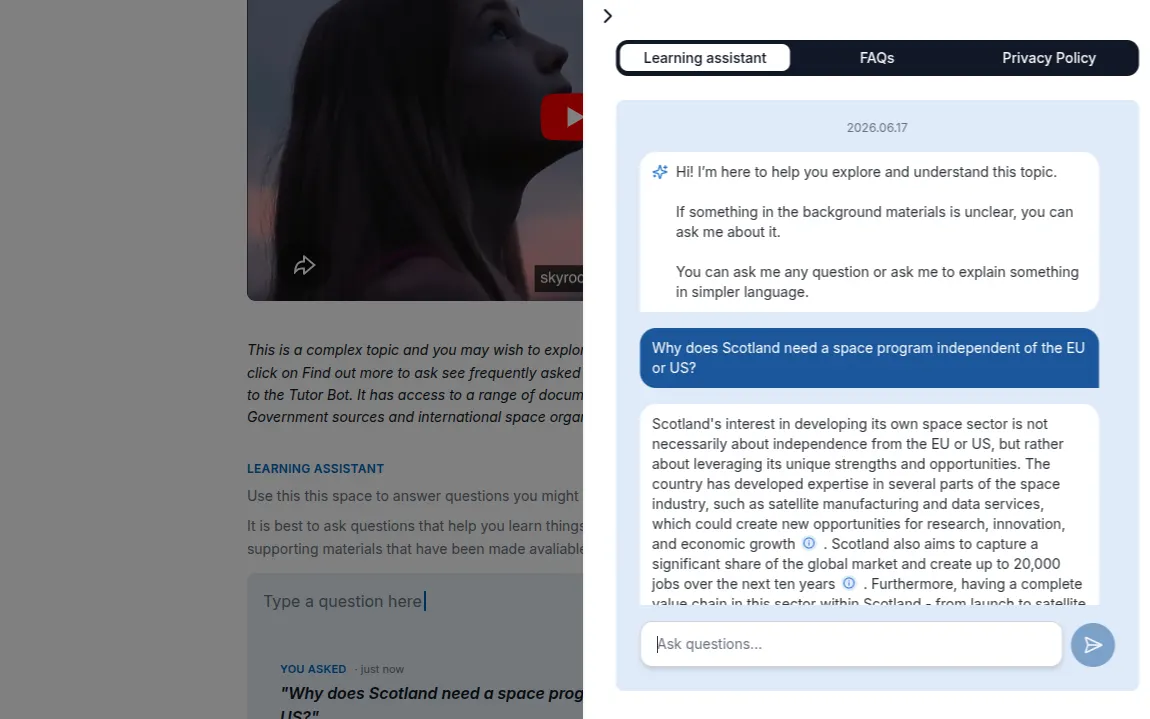 An example of using the Learning Assistant AI feature in a Comhairle deliberation on the Scottish space sector.
Later in the process, after the user has been exposed to a range of other participants’ perspectives, Comhairle’s Elicitation Bot helps users to formulate their own opinions and contributions to the deliberative process. The bot interviews the user about what they’ve learned about the topic and then extracts one or more structured claims based on the user’s responses. The user has the opportunity to approve, remove, or modify their statements. If they approve them, they are added to the bank of responses that other participants encounter and give feedback on. This is not unlike the AI Interviewer tool created by Japan’s Team Mirai and conversational survey tools like Harmonica; Harmonica and CrownShy are now collaborating on further development of the interviewer as partners with Metagov through a grant from the Mozilla Foundation.
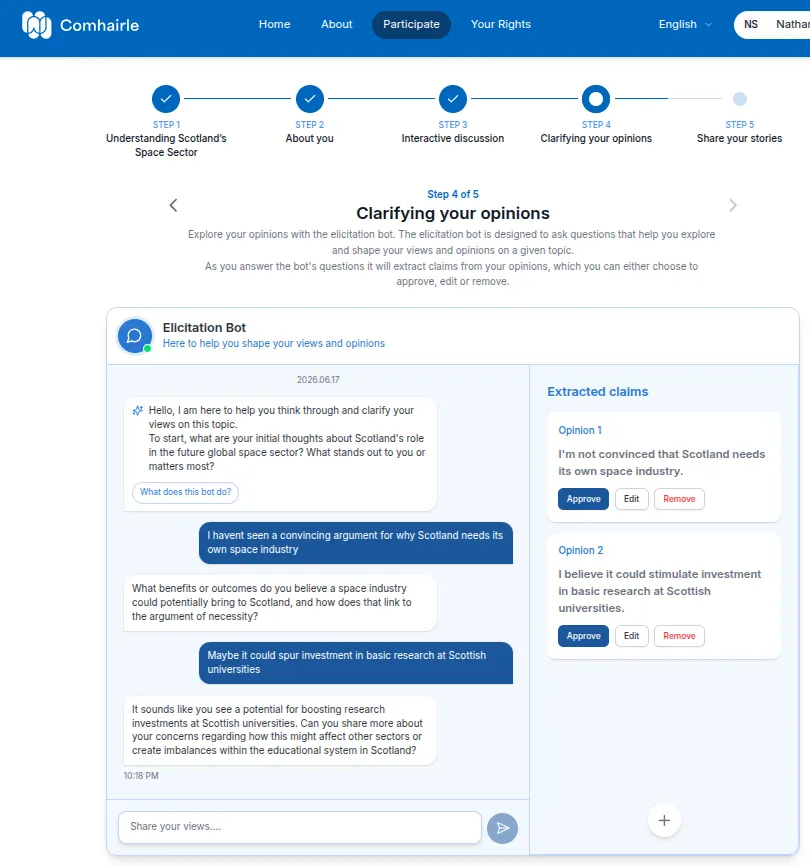 An example of using the Elicitation Bot AI feature in a Comhairle deliberation on the Scottish space sector.
Lynn articulated the ultimate goal of CrownShy: “How do we get to the point where this technology becomes boring, because it is so natural and engrained in decision processes? How do we make this into core infrastructure [for democracy]?”
The concept was born in 2024, motivated by the Scottish Government’s CivTech Challenge on public participation in decision making. Lynn and colleagues Liz Barry, the well-known open source technology & democracy movement organizer, Andy Paice, head facilitator, and Shu Yang Lin, head designer, joined forces to respond. The Challenge demonstrates Scotland’s vanguard status among global democracies in investing in accessible, scalable forms of public participation in policymaking. As the Challenge announcement put it, it is the “aspiration of the Scottish Government to evolve public participation from single initiatives to routine government business.“
After running several engagements within Scotland, Comhairle found its first use case in England through a collaboration with the UK think tank Demos in a project called Waves, funded by Google’s nonprofit arm (Google.org). Starting in April of 2026, this was a consultation of more than 1000 residents of South Staffordshire, England, to inform their local Council’s drafting of a housing development plan.
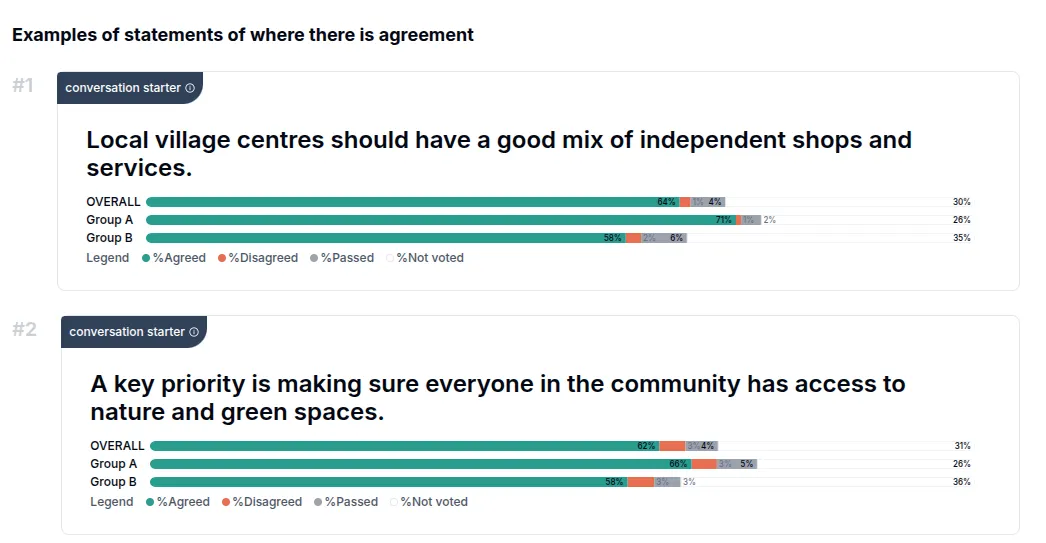 An example output from CrownShy’s Waves consultation on housing development in South Staffordshire, England.
We wanted to understand better why the Scottish government, in particular, is investing in this innovative approach to participatory democracy. Part of the answer may be cultural: Scots have a long and proud history of leading global scientific and technological advancement spanning the steam engine, the telephone, refrigeration, and more.
But another part of the answer is probably strategic. The Scottish Parliament was created only in 1999, and given powers devolved from the central UK government in London. Within little more than a decade, the Scottish National Party took majority control of Parliament on a platform including the promotion of Scottish independence and, ultimately, restoring membership in the European Union. As the question of Scottish independence and the instability of the UK government has roiled British politics, trust in government grounded in transparency and open participation has become a point of pride and source of strength for the Scottish government and its ruling party.
Yet, this strength seems to be eroding. The SNP enjoyed about a decade of majority representation in Parliament until just the past couple years, when their support has declined. Meanwhile, the advancing Reform UK party threatens, should they take power from the weakened Labor party in Westminster, the abolition of the Scottish Parliament and its independent, devolved powers. Scotland has measured a long term decline in trust in government.
As of 2025, Scottish residents still express that government engagement with citizens is the strongest driver of trust in government, and yet only 10% of Scottish residents report engagement with a public meeting and 16% reporting responding to a consultation within the past few years. Given this data and the stakes at play, the Scottish government is understandably prioritizing expanding the scope and visibility of public participation in government.
Lynn and the CrownShy team coordinated with the Scottish government heavily on the development of Comhairle. Among their key stakeholders are Tom Wilkinson, Chief Data Officer for The Scottish Government, who has been an advocate for using technology for public participation and collective decisionmaking in government and Doreen Grove, Head of Open government at The Scottish Government, who is a long term champion for transparency and open data and processes in Scottish government.
Through the government’s CivTech challenge, the CrownShy team receives funding to develop their technology platform. The Scottish government benefits from a perpetual license to use the software going forward. CrownShy intends to maintain and operate the platform as a software service, hoping to attract other public as well as private clients. Lynn hopes these paying customers will also subsidize CrownShy’s operation of the platform to be used for free by communities.
As ambitious as CrownShy’s current work is, Lynn is also thinking of even bigger things. He shared a vision for a more decentralized approach to deliberation. Under this approach, no legislature or single entity would control the deliberative process, how public inputs are synthesized, or whose inputs are taken into account. Instead, deliberations would look more like a debate in the public square than a debate in a state house. Anyone could publish their point of view, anyone could publish a synthesis of the broader discourse, and anyone could verify whether the organizers are correctly representing what conclusions participants reached.
It’s this last vision of a decentralized, fully distributed deliberative capability that resonates most with Lynn’s roots in citizen science. Civic technology is not just a tool to help powerful institutions make sense of the perspectives of their constituents and engender trust among them. It’s much more of a two way street. Civic technology can crack open the rarefied functions of those institutions so that any of us can not only understand them, and not only participate in them, but maybe even help to author their future ourselves.