Rewiring Democracy Now: AI & the Struggle for Open Knowledge in Brazil
An article for The Renovator about Open Knowledge Brasil and the sustainability of open source civic technology.
This article was written with Bruce Schneier and originally published by The Renovator.
This is the third in a multi-part series by Sanders and Schneier going into depth on real-world examples of democratic technologies from their book, Rewiring Democracy: How AI Will Transform Our Politics, Government, and Citizenship. Their first piece was about the Japanese digital democracy party “Team Mirai” and their second was about the Swiss Public AI model “Apertus.”
It’s not an easy time for those trying to do good in the world, especially for those in the Global South. Financial pressures from the collapse of foreign aid, surging energy costs, and inflation combine with rising authoritarianism and a backlash to social reform. This all challenges the survival and fundamental mission of civil society groups and activist organizations.
Despite this, there are inspiring examples of public interest nonprofit organizations using AI to sustain and advance their work – one of them in Brazil. We spoke to Haydée Svab, Executive Director of Open Knowledge Brasil (OKBR) in February to learn more about how her organization is responding to this difficult environment. OKBR is a chapter of the international Open Knowledge Foundation, founded in 2013. It’s a pioneer in the responsible use of AI and machine learning in civic technology. We used one of OKBR’s earliest projects as a case study in our book, Rewiring Democracy: How AI Will Transform Our Politics, Government, and Citizenship, and were inspired to learn about their accomplishments—as well as their resilience through hardship—in the years since their foundational work.
OKBR’s most prominent project began in 2016, about six years before the widespread use of modern large language models. A group of concerned citizens in Brazil built an AI to root out public corruption in their government. The bot, affectionately named Rosie, watched every expense filed by every Congressperson. When it found an anomalous receipt, like a two thousand dollar (USD) lunch or maybe the purchase of a goat, it tweeted those stories for the world to see.
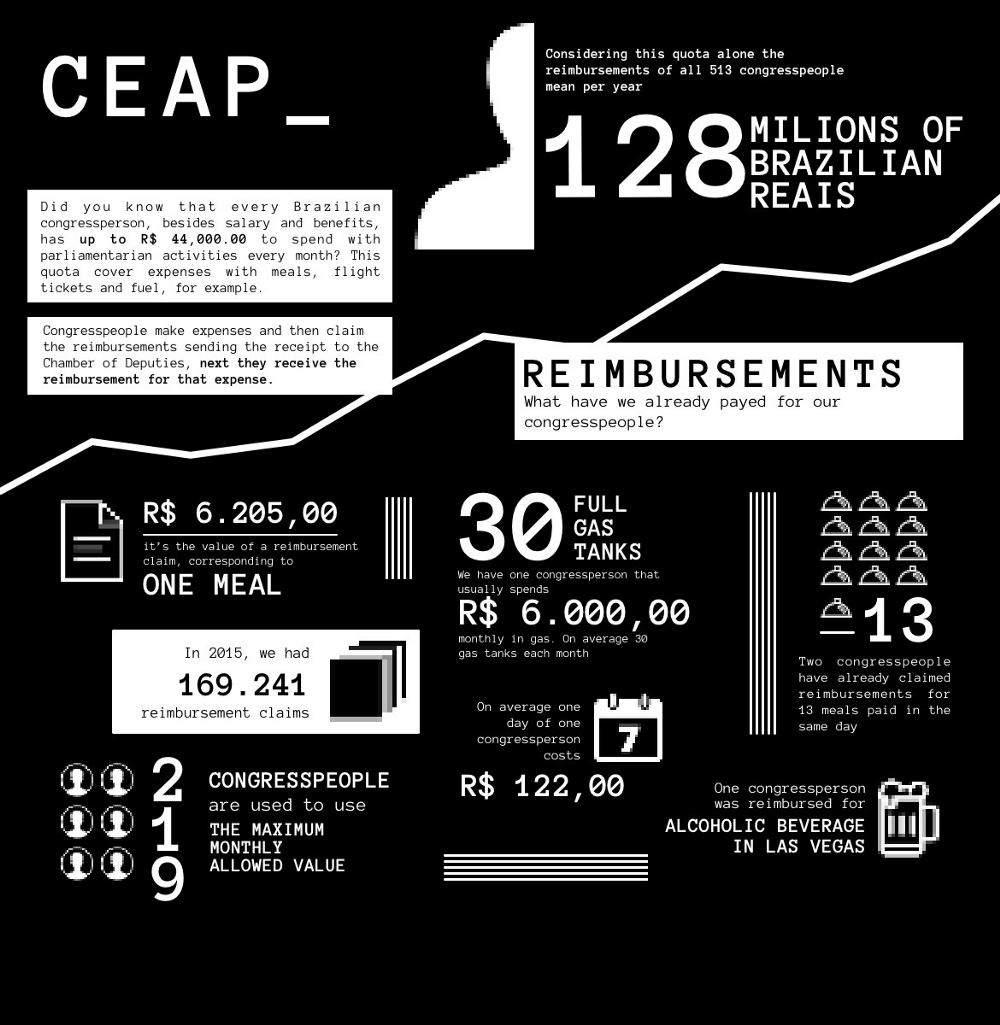
The project was Operação Serenata de Amor (OSA), translating to Operation Love Serenade, named for a Brazilian candy. The name was an homage to an infamous European public corruption scandal involving improper purchases of chocolate bars. OSA was led by a multi-disciplinary team of contributors initially unaffiliated with OKBR, including the founder Irio Musskopf, a data scientist; the sociologist Eduardo Cuducos, the activist and researcher Yasodara Córdova, and data scientist Jessica Temporal.
OSA’s process uses machine learning to prioritize suspicious charges among millions of public expense reports, which a human audits before they are reported. OSA’s leaders were disappointed that the federal authorities did not prosecute the officials alleged to have misused funds. In 80% of cases, they didn’t respond at all. But when they used social media to publicly shame the politicians, they spurred at least some voluntary return of funds.
OSA was initially a loose open-source collective, but became part of OKBR in 2018. OKBR provided them with administrative, legal, and limited ($1400 USD) financial support.
The story of OSA influenced countless digital watchdogging applications that came after. In our first article in this series, we wrote about Team Mirai’s Japanese financial transparency app, one of many following in the spirit of Rosie. And yet, the open source codebase for OSA has not had a substantive update in about six years, and its developers acknowledge it is dormant. OSA’s expense report dashboard, Jarbas, is no longer online. This cycle of success and then disappearance is far too common in the civic tech field.
Sustaining civic technology
The Civic Tech Field Guide tracks scores of government transparency applications which have, like OSA, ceased operation. These projects sometimes ended after running their natural course. More often they lacked financial sustainability, or encountered functional or organizational failures. Despite the best efforts of project founders, the sincere good intentions of so many contributors, and even the occasional infusion of funding, a huge fraction of the landscape of civic technology is a graveyard.
Svab shared with us the wrenching struggles OKBR faces in continuing to operate useful projects like OSA. An already difficult funding environment got much harder in 2025, when the Trump administration effectively shuttered USAID. While Svab said that OKBR never directly received money from USAID, it has felt the downstream impact of the systemic funding crunch induced by its closure. Philanthropists seeking to plug holes from USAID have less to give to projects like OKBR. OKBR has shrunk from 15 to 8 staff, all part-time, and is increasingly reliant on volunteer labor.
Of course, volunteer contributions have always been an important lifeblood of civic technology projects globally. Svab says they have experimented with partnerships with local private companies to recruit skilled professionals from their staff to volunteer with OKBR. One of our own projects, the Massachusetts Platform for Legislative Engagement (MAPLE), has been built by a volunteer team sourced through Code for Boston under a similar model. (Disclosure: MAPLE is a fiscally sponsored project of the 501c3 Partners in Democracy-Education, founded by The Renovator publisher Danielle Allen.)
The successors of Operação Serenata de Amor
Svab explains Querido Diário and other current work of Open Knowledge Brasil in a 2025 video recorded for the New.Commons challenge.
In 2018, some of the developers of OSA launched Perfil Político (Political Profile) as a project of OKBR. This was an open source tool drawing on public data from the Brazilian Superior Electoral Court, Chamber of Deputies, Federal Revenue Service, and elsewhere to construct public profiles of election candidates. It aimed to give voters tools to understand where money was being raised in elections and how representative different Brazilian states were of their electorates with respect to race and gender. Generally, it attempted to arm people with more information about the recipients of their votes. The tool was developed within OSA’s Data Science Program for Civic Innovation (Programa Ciência de Dados para Inovação Cívica). Since 2022, Perfil Politico has also not been updated.
Around the same time in 2018, OKBR also founded the Embaixador(a,e)s program, translating to “Ambassadors,” gender inclusive. The Ambassadors are researchers, advocates, engineers, data scientists, and other types of volunteers charged with promoting civic innovation projects, open data, and transparency. The Ambassadors site has not been substantively updated since 2024.
The challenge with sustainability is undermining tools of great value to the public.
A primary charge of the Ambassadors has been to represent and promote the flagship civic innovation program of OKBR, Querido Diário (QD, meaning Dear Diary). The name Dear Diary refers to Diário Oficials, the official “gazettes” through which Brazil’s federal government, states, and many of its more than 5,500 municipalities each publish laws and administrative acts. Since the project focus was established in 2019 and since the platform was launched in 2021, OKBR’s QD project aims to compile those municipal gazettes into a single, highly usable, accessible dataset, and to drive public impact through that data.
The homepage of Querido Diário, obtained March 30th, 2026.
Svab described QD as irrigating the information desert that is local government in Brazil, by providing a backbone for municipal open government data. Instead of leaving constituents to trawl through variously formatted PDF documents to understand government disclosures, QD’s scrapers and data processing pipeline produce uniform datasets for gazettes from 469 individual municipalities collectively covering a third of the Brazilian population.
Environmental causes have been a major impact area for QD. OKBR has joined with five other organizations to help lead the Diários do Clima (Climate Diaries) project, which combines QD and other data sources to help journalists monitor local government decision-making on environment and climate.
At times, the stakes of the project have been life and death. On multiple occasions, researchers have used QD to uncover public corruption, neglect, and malfeasance that contributed to deadly flooding. For example, the floods in Rio Grande do Sul in 2024 displaced more than half a million people and killed at least 160. Investigative journalists at The Intercept in Brazil used QD to establish that the chief inspector responsible for assessing the work of the maintenance contractor for the state flood protection system, Bombas Sinos, was hired to join the leadership of that very same contractor.
An investigation ultimately declared the flooding an act of nature rather than a consequence of neglect, but did note failures in the floodgates, pumps, and dikes. The Intercept’s exposure of this revolving door system raised alarming questions of ethics, conflicts of interest, and accountability. Several further investigations using Dear Diary have been conducted in partnership between OKBR and Brazilian scholars as part of their Dear Diary at Universities program.
Climate Diaries operates a paid subscription service. “Pro” tier subscribers gain access to an AI assistive feature, which monetizes the transformer-based semantic theme-classification functionality of the QD data processing pipeline to make search and monitoring of environmental issues easier.
We see this kind of automated surfacing of useful information as an emerging category of AI assistive civic innovation products. Another example in the category are the AI Tip Sheets produced for journalists by the California-based newsgathering nonprofit CalMatters, which gives journalists tools for discovering stories of public influence or corruption from the data sources of CalMatters’ Digital Democracy project.
Beyond product integrations like semantic search and AI tip sheets, Svab sees AI as part of the solution to sustainability for projects like QD. While economic pressures make paid staff and volunteer time more scarce, the effectiveness of AI coding assistive tools makes it possible for fewer and less specialized developers to maintain complex projects like QD. While AI might helpfully lower software development costs and increase the range of tasks that staff and volunteers can perform, it won’t replace lost revenue sources or fully solve the sustainability problem for civic technology developers.
Svab is a transportation engineer by training and came to this work on democratic transparency through the open source software movement. As a student at the University of São Paulo, Svab co-founded a student free software study group called PoliGNU. Among PoliGNU’s projects were CADLivre, a suite of Free software tools for engineering design, and Radar Parlementar, which used legislative voting data to measure alignment between Brazilian political parties. Svab spent five years working as a civil engineer for the state-owned metro operator in São Paulo, Cia do Metropolitano de São Paulo before joining OKBR as the Executive Director in 2024.
Svab described the parallels between the free software and pro-democratic movements, which have manifested in her own career. As she has moved from PoliGNU to OKBR, providing tools for digital autonomy—either from government or corporations— decentralizing power and producing transparency have remained central themes in her work.
Not long before Svab’s student days, legal scholar Yochai Benkler and philosopher Helen Nissenbaum wrote about the free software movement as a commons-based system for digital peer production that propagates virtue in societies. In other words, the model of open source software development lends itself not only to producing good code, but also to steer groups towards civic-minded behaviors that produce public-interested outcomes. Their formulation suggests that free software makes civic innovation more feasible, because it provides individuals with a means to do socially helpful things cooperatively with others on a scale previously not possible.
Twenty years after Benkler and Nissenbaum’s writings, we have seen plenty of reasons to criticize those lofty ideals. Nor are the problems of sustainability simply about the business models of these non-profit organizations. Their value tempts interference and capture and the precarious economics of producing public goods leaves them vulnerable.
In Africa, the idea of digital sovereignty has become associated with internet shutdowns and government control of access to information. To many, Microsoft’s subjugation of GitHub—long the dominant organizing platform for free software—within its “CoreAI” division in 2025 was a stranger-than-fiction realization of the capitalist co-opting of open source. Microsoft’s billions of dollars, for a time, supported a thriving open source ecosystem, which was then used to train large language models that supercharged the company’s wealth into the trillions. In a total transformation of the open source economy, Microsoft now charges open source developers to access the models trained on their labor.
Yet these dangers only reinforce the power of what is being developed in the civic tech context. Microsoft and many others have rightly understood the value and power in open source software development.
In Brazil in particular, free software has had a politically potent history. Sérgio Amadeu da Silveira led the adoption of free software, including an “electronic government” initiative in São Paulo, arguing that “digital inclusion”— universal access to the Internet and digital capabilities— was a force of resistance against foreign monopolistic technology companies. Silveira later led a national free software action plan as part of the first administration of President Luiz Inácio Lula da Silva, drawing on the ideas of Benkler and others to frame the use of free software as a matter of technological autonomy.
Examples like OKBR and the technology development cooperative EITA in Brazil serve as exemplars of a broader Free culture movement in Latin America, demonstrating, per Leonardo Foletto and Daniel Santini, an “alternative model where technological development serves collective emancipation rather than capital accumulation.”
In the second article in this series, we wrote about the Swiss Apertus model demonstrating an alternative model for AI development: Public AI instead of Corporate AI. The Swiss developers, too, are seeking to build sustainable organizations around their project. For as many challenges as they have encountered, the ongoing impact of OKBR through its modern projects like Querido Diário demonstrates the potential of digital activism and civic innovation when paired with solidarity and resilient leaders.
The question of whether that potential can be fully activated for the public good, though, will depend on solving the problem of producing civic technology sustainability.